
Low self-weight is precisely why wind uplift—not downward pressure—governs the design of tensile membrane structures. Because the membrane cannot rely on mass to resist suction, engineers turn this characteristic into an advantage through three mechanisms:
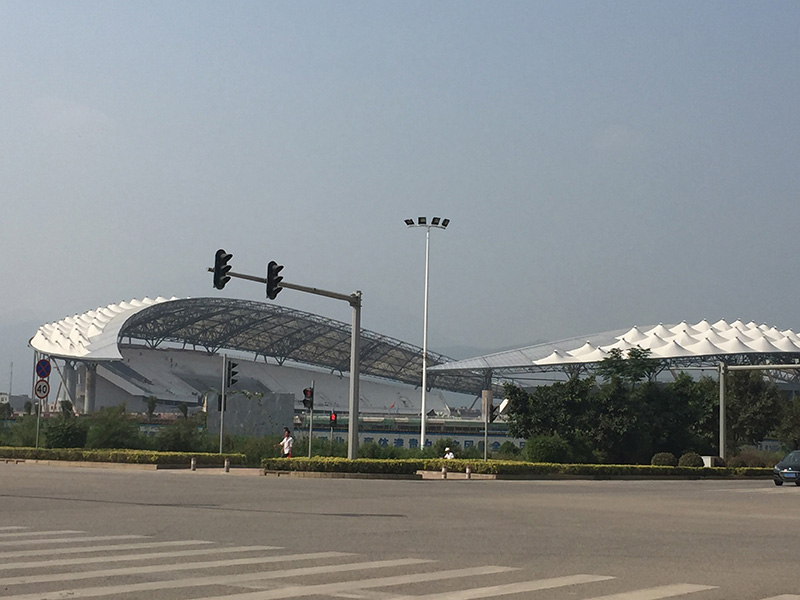
* Prestress as structural stiffness. The fabric is tensioned during installation to a level high enough that the membrane remains stable under wind and snow. Prestress, rather than weight, provides the geometric stiffness that resists fluttering and uplift.
* Aerodynamic shaping. Doubly curved forms—saddle shapes, convex cable trusses, and streamlined surfaces—reduce wind pressure concentrations and avoid the local stress peaks that initiate tearing.-
* Tension transfer to a stiff support system. Wind forces are collected by cables, clamps, and edge details and transferred to a steel or cable structure and, ultimately, to foundations designed for uplift and lateral loads.
In short, a tensile membrane does not “fight” the wind with mass; it manages wind through geometry, prestress, and disciplined load paths.


 خدمة الإنترنت
 +8613600065322
 canobbio@canobbio.com.cn
 +8613600065322


